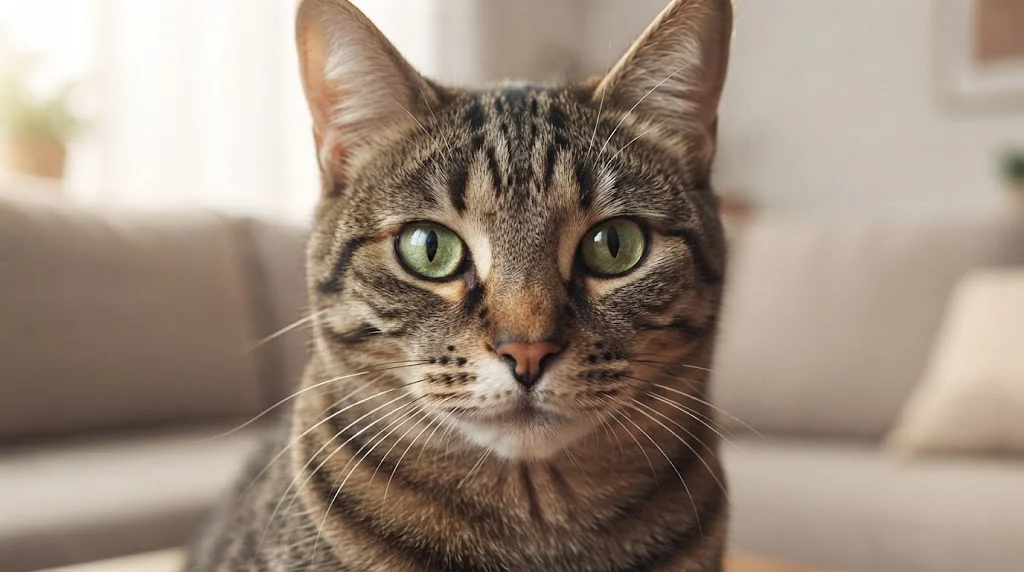
Have you ever felt eyes fixed on you while you’re working or resting? You turn around, and there’s your cat, watching you intently. It’s a very common scene for those who live with cats, and one that can sometimes raise questions.
A cat’s gaze is one of its forms of communication. Through their eyes and other gestures, they can express how they feel, show interest in what’s happening around them, or get our attention when they need something.
Understanding what it might mean when a cat stares at you helps you better understand its behavior and respond to its needs. In this blog post, we explain five reasons based on feline behavior and everyday situations that might be behind that stare.
1. A Language Refined Over 8,000 Years
The relationship between people and cats is nothing new. Studies on evolution and domestication date the beginning of this coexistence to about 8,000 to 10,000 years ago, during which time both species have learned to live together.
Over this time, a cat’s gaze has become one of the ways they interact within the home. While wild cats communicate primarily through scents and other signals, domestic cats also use gestures, sounds, and eye contact to interact with people.
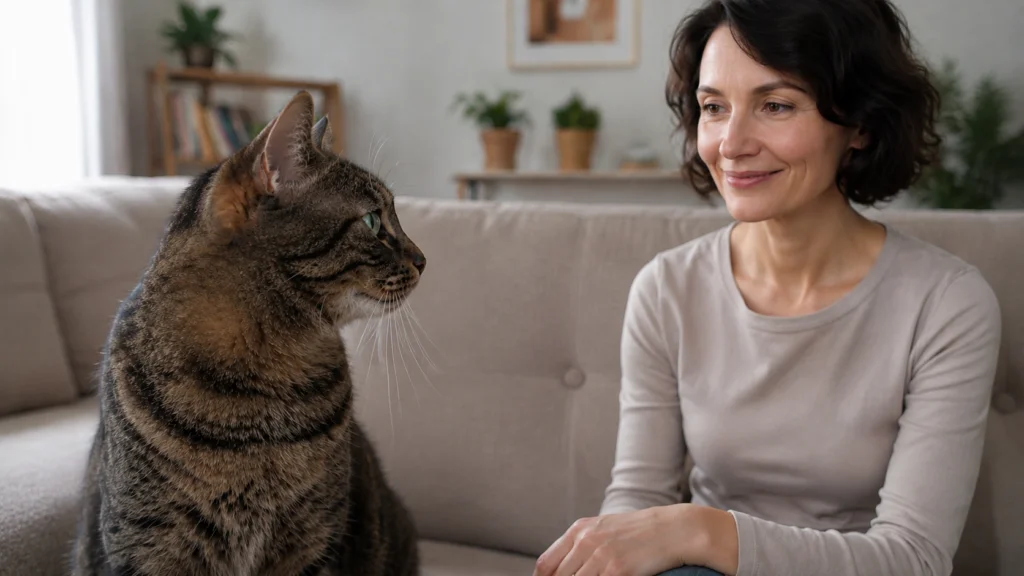
How have they adapted to living with us?
- They use eye contact and other gestures to get our attention.
- Meowing is a key part of many of their interactions with people.
- They observe our routines and can anticipate regular moments, such as mealtime or playtime.
That’s why, when a cat watches a person, it may be paying attention to what’s happening or waiting for something familiar from its routine to occur. Understanding these habits helps us better interpret their daily behavior.
2. The Biological Secret Behind “Invisible Blinking”
Cats have a very unique eye anatomy that allows them to keep their eyes open for quite a long time. One of the features that helps explain some of the peculiarities of a cat’s gaze is the third eyelid.
This structure, known scientifically as the nictitating membrane, is a thin layer located on the inner surface of the eye. Its function is to help clean, moisten, and protect the eye’s surface while the cat remains alert to what’s happening around it.
What is the purpose of this special eyelid?
- It helps keep the cornea moist and protected.
- It helps remove small particles from the surface of the eye.
- It protects the eye while the cat remains alert to its surroundings.
That’s why, when a cat seems to stare for a long time without blinking, it doesn’t necessarily mean there’s something wrong. Its eye anatomy includes mechanisms that help keep its eyes protected while it observes what’s happening around it.
3. A Sign of Trust: Slow Blinking
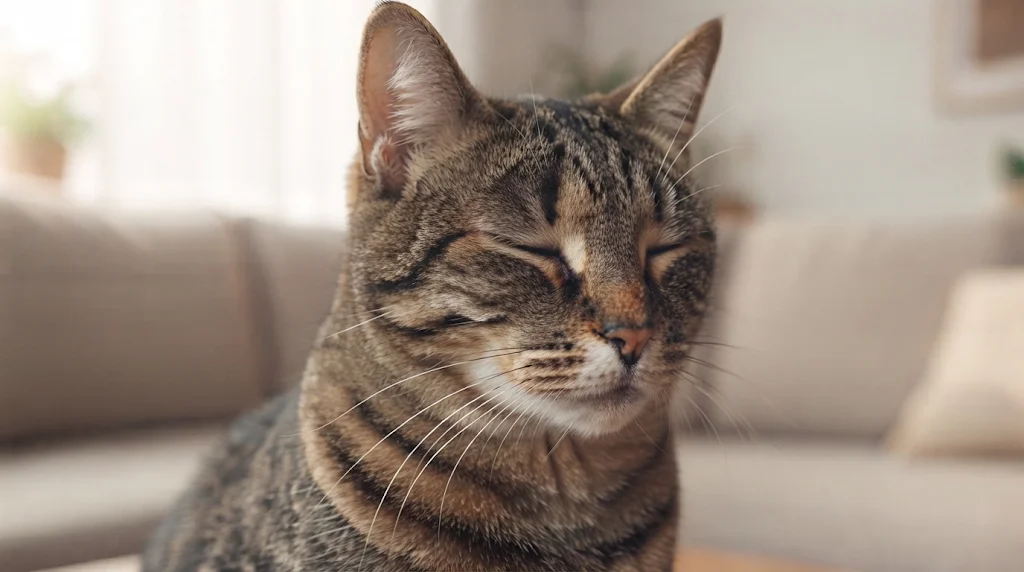
Although a fixed gaze may seem intense, its meaning depends on the context and the other signals accompanying the behavior. When a cat is calm, it may use its eyes as part of its interactions with the people it lives with.
In 2020, researchers from the Universities of Sussex and Portsmouth conducted a study published in the scientific journal *Scientific Reports*. The research, led by Tasmin Humphrey and Karen McComb, analyzed what is known as “slow blinking” and found that this behavior promotes positive interaction between cats and people.
How to respond to slow blinking:
- When you notice a cat looking at you, look back at it with a relaxed expression.
- Slowly close your eyes for a couple of seconds and open them calmly.
- Then, let the cat decide if it wants to continue the interaction.
This simple exchange can be a way to build trust as you live together. Slow blinking may occur when a cat feels calm and comfortable in a person’s company.
4. Away to observe what’s happening around them

Cats are very observant animals. Over time, they can become familiar with our movements, our voices, and our routines, so it’s normal for them to pay attention to what we do.
A study by the Universities of Lincoln and Nottingham, published in the journal PLOS ONE, analyzed the relationship between people’s personalities and their cats’ behavior (Finka et al., 2019). The results showed a link between certain personality traits in people and specific behaviors in the cats they live with.
For this reason, a cat’s gaze may reflect its attention to what’s happening at home. If a person is restless, moves quickly, or changes their tone of voice, the cat may follow them with its eyes and appear more alert. Conversely, when the atmosphere is calm and the person is resting, the cat may stay close by and adopt a relaxed demeanor.
These small interactions are part of daily life together and allow us to better understand each cat’s personality and habits.
5. A Way to Express Their Needs
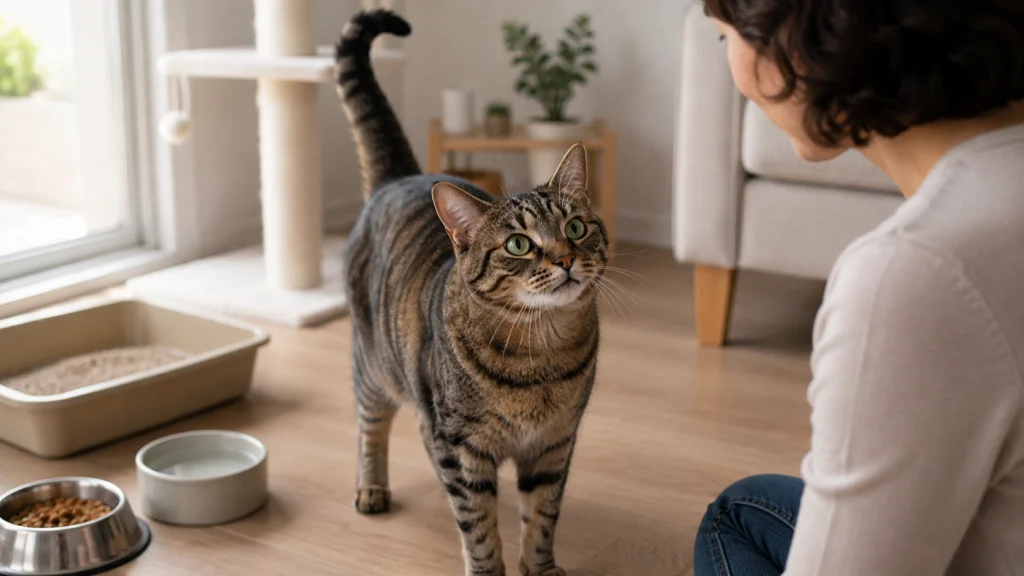
Finally, a cat may stare because it wants to get our attention. It might be time to eat, it might want to play, it might need a door opened, or it might simply be seeking companionship.
However, to accurately understand a cat’s gaze, it’s important to pay attention to its overall body language. The eyes shouldn’t be interpreted in isolation; the position of the ears, tail, posture, and vocalizations can also provide information about what the cat is feeling or needs.
Learn to observe their full body language:
- Arelaxedbody,gentleeyes,andaraisedtail:this may indicate calmness, curiosity, or a desire for attention.
- Ears pinned back, body tense, and dilated pupils: this may indicate fear, anxiety, or discomfort. In this case, it’s best to respect their space.
- Asoftmeowwhilelookingattheirfoodbowlorlitterbox:they may be drawing attention to a basic need, such as food or cleaning their space.
Learning to interpret all these signals helps you better respond to a cat’s needs and fosters a relationship based on trust, respect, and care.
At Sepicat, we care about cats’ well-being, and we know that understanding their subtle cues is an important part of living together. Understanding a cat’s gaze can help us recognize some of the ways they communicate and build a bond based on trust and care.
If you’d like to continue learning more about cat behavior, well-being, and care, we invite you to keep reading our content. You’ll find information and tips to better understand their needs and enjoy a more peaceful and pleasant life together.
Frequently Asked Questions
1. Do cats see the same way humans do?
Not exactly. Cats have vision adapted to detect movement and navigate in low light, although they cannot see in complete darkness. They also perceive a more limited range of colors than humans. These characteristics influence how they observe their surroundings and react to different stimuli.
2. Can cats follow a person’s gaze?
Yes. Cats are able to focus their attention on the same spot a person is looking at, especially when there’s a stimulus that piques their interest. This ability can help them gather information about what’s happening around them and is part of their social skills.
3. Why do some cats stare before approaching?
Observing before approaching may be a way to assess the situation. Cats often pay attention to a person’s movements and behavior before deciding whether to approach. Therefore, it’s advisable to let the cat approach at its own pace and avoid sudden movements.
4. Could achange in a cat’s gaze be related to a health problem?
Yes. A change in the appearance of the eyes or in the cat’s usual way of looking can be a sign that something is wrong. Cloudy eyes, excessive tearing, discharge, squinting, or pupils of different sizes are some changes that require veterinary attention.
5. Can age affect the way a cat perceives its surroundings?
Yes. As cats age, changes in vision and other senses may occur. Older cats may also exhibit behavioral changes, such as disorientation or alterations in their routines. If you notice a noticeable change in their behavior or in the way they respond to their surroundings, it’s advisable to discuss it with a veterinarian.