Cats are known for being agile, well-balanced, and able to navigate heights with ease. However, this ability doesn’t mean they’re immune to falls.
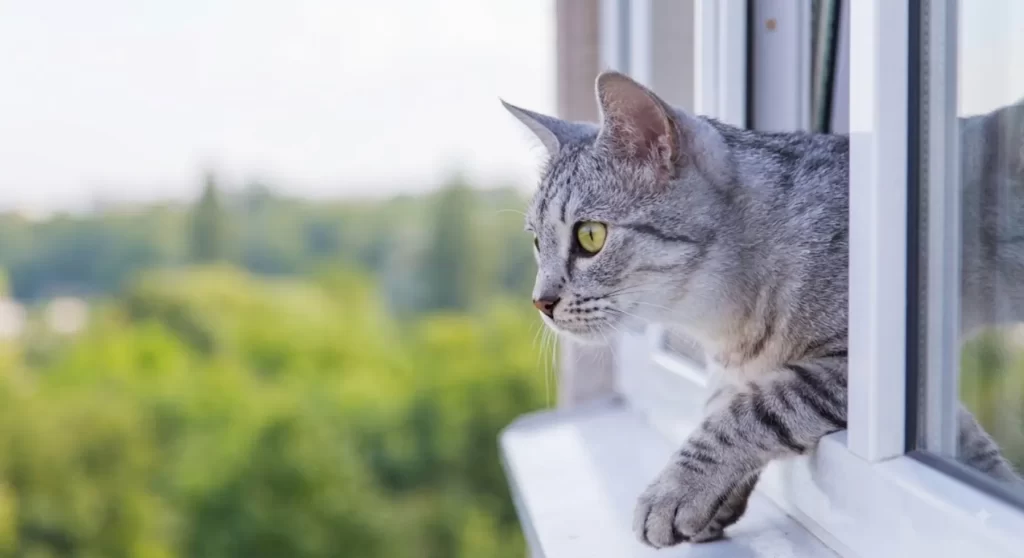
An open window, an unprotected balcony, or even an insect that triggers their hunting instinct can put them in a dangerous situation in a matter of seconds.
“Cat Skydiver Syndrome” refers to the injuries that can occur when a cat accidentally falls from a height. Although their bodies have natural mechanisms to stabilize themselves during a fall, these do not guarantee that the impact will be harmless.
That’s why understanding how these accidents happen and making adjustments to your home can help reduce the risks without limiting your cat’s curiosity and natural behaviors.
1. The myth of the seven lives: curiosity can also be dangerous
The idea that cats “always land on their feet” has contributed to a false sense of security around heights. Their sense of balance is extraordinary, but that doesn’t mean they can accurately calculate all their movements or anticipate the consequences of a jump.
A cat may be drawn to something as simple as a bird, an insect, or any stimulus on the other side of a window. In that moment, its hunting instinct may cause it to focus on reaching its target and pay less attention to the danger posed by the drop.
There’s also another factor: confidence. Cats can walk along narrow surfaces, railings, or elevated furniture with ease, but a wet, slippery, or unstable surface can cause them to lose their balance.
That’s why preventing “cat skydiving syndrome” doesn’t mean completely eliminating heights, but rather creating an environment where your cat can safely explore and express its natural behaviors.
2. The Science Behind Landing: Why Landing on Their Feet Isn’t Always Enough?
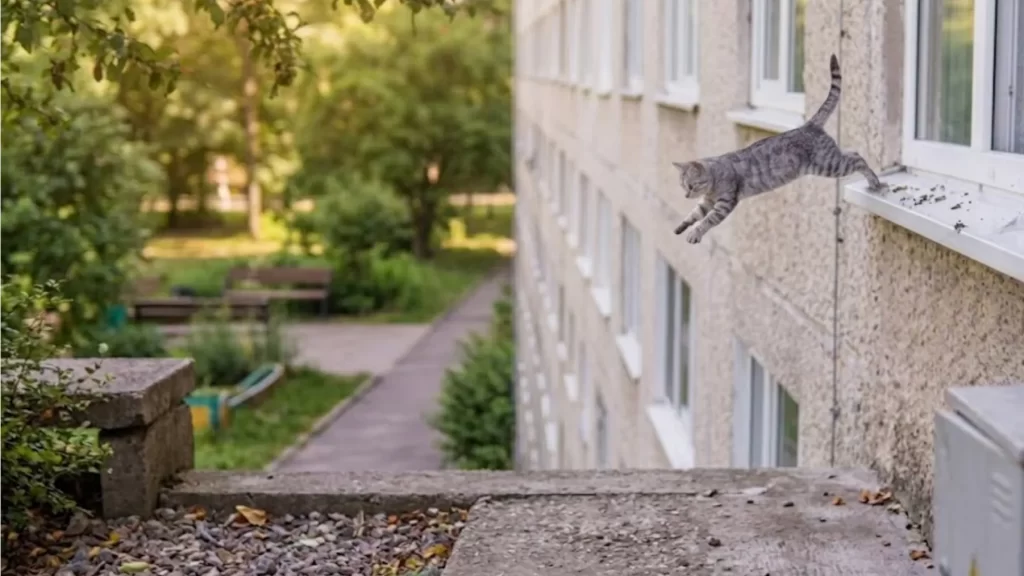
Cats have a mechanism known as the righting reflex, which allows them to adjust their body position during a fall to try to land on their feet. This process involves their vestibular system and the coordination of different body parts while they’re in the air.
However, this mechanism has limitations.
When a fall occurs from a very low height, the cat may not have enough time to complete the orientation movement. In a fall from a greater height, on the other hand, the impact can generate forces capable of causing injuries even if the cat manages to adopt a proper position.
Furthermore, the impact does not necessarily affect only the limbs. Depending on the circumstances, injuries can also occur in other areas of the body that are not always immediately apparent.
Understanding these limitations is important for grasping why “cat parachute syndrome” can occur even when the cat appears to have landed correctly. Therefore, just because a cat lands on its feet doesn’t necessarily mean it has escaped unscathed.
3. How to Adapt Your Home to Prevent Falls
Cats are curious animals and have a natural tendency to explore high places. Therefore, preventing skydiving cat syndrome doesn’t mean stopping them from climbing or peering over edges, but rather creating an environment where they can do so safely.
Windows and Balconies: Key Areas to Check
Windows are one of the first places you should check. Standard window screens, for example, aren’t necessarily designed to support a cat’s weight or strength, so they shouldn’t automatically be considered safety features.
Tilt-and-turn windows also require special attention, as their opening mechanism can create gaps that a cat might try to squeeze through or get stuck in.
On balconies and patios, check the entire perimeter. Inspect the gaps between railings, the height of the guardrails, and any objects near the railing that could be used as a foothold.
The safety barrier must adequately cover potential entry or escape points, leaving no gaps that could pose a risk.
Height, Yes—But Safely
Completely eliminating high places in the home isn’t always the best solution. Cats need to climb, observe, and have spaces from which they can monitor their surroundings.
One alternative is to provide them with safe options indoors, such as stable scratching posts, cat trees, or securely anchored shelves.
Location is just as important as the structure itself. These spaces should be kept away from unprotected windows, balconies, and other areas where a fall could occur.
It’s also a good idea to periodically check that the structures remain sturdy and are suitable for your cat’s weight and movements.
This way, you can provide your cat with opportunities to explore and enjoy the heights within a controlled environment.
What to Check at Home?
- Windows and balconies: Use appropriate safety systems and periodically check that they remain secure and in good condition.
- Furniture and high surfaces: Avoid placing furniture, shelves, or planters near areas from which your cat can easily access a window or railing.
- Exploration areas: Provide safe options for climbing, observing, and resting.
- Stability and safety: Make sure their play, rest, and exploration areas are stable and located away from potential fall hazards.
4. How can you tell if your cat is okay after a fall?
Cats may seem calm after an accident, but some injuries aren’t immediately obvious. Even if your cat manages to get up and walk after the fall, it’s important to monitor how they’re doing in the hours that follow.
Pay attention to any changes in the way your cat walks, breathes, moves, or reacts. Some signs may indicate that your cat needs veterinary care:
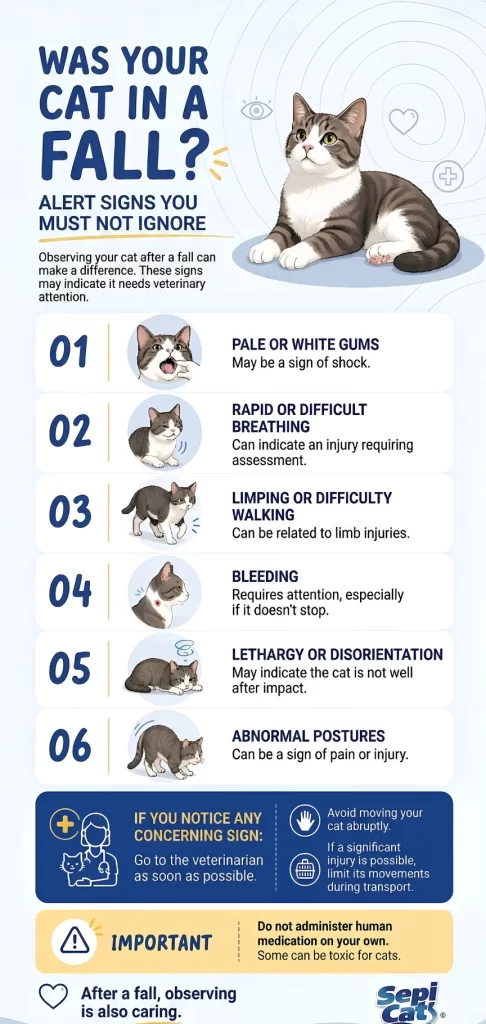
After a fall, knowing your cat’s usual behavior can help you detect changes that might otherwise go unnoticed. A change in demeanor, reduced mobility, or any alteration in its general condition are reasons to pay special attention.
A fall related to skydiving cat syndrome doesn’t always have immediately visible consequences, so monitoring its progress can be key to detecting any significant changes.
If you have any concerns about your cat’s condition, a veterinary evaluation is the best way to confirm that they are okay and to take timely action if they need care.
A safe home is also part of a cat’s well-being
Preventing a fall doesn’t mean limiting your cat’s curiosity, but rather providing an environment designed with its safety in mind. Their agility, love of heights, and natural behaviors are part of what makes cats special, but they also need a space tailored to their needs.
At Sepicat, we view cat care as a holistic commitment. That’s why, in addition to developing solutions designed for the well-being of cats and their homes, we share information that can help you care for them and promote their well-being in everyday life.
Download our infographic “Cat Fall Syndrome: Warning Signs” to have the key points at your fingertips—what to look for after a fall and how to respond. Plus, follow our advice and tips to discover new ways to care for your cat and create an environment where they can explore, rest, and enjoy themselves more safely.
Frequently Asked Questions
1. At what height does a fall become dangerous?
There is no such thing as a completely safe height. The risk depends on various factors, such as the distance, the impact surface, and the cat’s position during the fall. That’s why it’s important to understand what “cat skydiver syndrome” is and how to prevent these types of accidents at home.
2. Are young cats at greater risk of falling?
They may be at greater risk due to their curiosity and exploratory behavior. That’s why it’s important to cat-proof your home from their earliest months and pay special attention to windows, balconies, and other elevated areas.
3. Can a cat fall even if it’s familiar with the space?
Yes. A bird, insect, noise, or sudden movement can distract them and cause them to lose their balance. These situations may be related to skydiving cat syndrome, especially when they occur near windows or balconies.
4. Can furniture near windows increase the risk?
Yes. Shelves, plant pots, or furniture can make it easier for a cat to reach a window or an elevated area, so it’s best to keep them away from these spots.
5. How often should I check the safety measures?
It’s recommended to check them periodically to ensure that the screens, nets, and fasteners remain secure and undamaged.