One of the first things we must teach our kitten when he comes home is the use of the sandbox, although many cats already come with the lesson learned by imitating their mother.
Cats are very clean and organized in this respect, but that doesn’t mean that we should not teach them how to use the litter box and be patient if they don´t understand it at first time.
Educating our kitten is a process that requires patience and love to adapt to the rules of the home.
Here are some tips on teaching your cat to use the litter box.
Tips for the cat to use the litter box
• Placing the sandbox
The place chosen for the sandbox has a great influence on whether the kitten wants to relieve herself there or not.
We must choose a place far away from the transit area of the house and from loud noises like a washing machine or similar.
In addition, it should not be near his feeder or drinker to avoid that he rejects it for being too close to his zone where he feeds.
If by any chance your kitten likes a certain corner or place in the house, we recommend you place her tray in that spot so she can get used to using it.
If this is a place that your kitten has grown to like for her own needs, we recommend that you leave it as the final location. If, on the other hand, it’s an area where it’s not possible to keep the litter box, once she’s used it regularly, you can gradually move her around.
It is important to take into account that we should not change the sandbox from one day to another but to move it little by little and always showing our cat where it is located.
• Show him the sand and sandbox
When the kitten arrives home we must go to the sandbox and show it to him, this moment is fundamental so that the feline explores it and gets used to it.
Cats cover their needs once they are finished so one way to get their attention is to stir the sand in front of them to encourage them to go in and explore.
It is important to keep in mind that we use the sand that we use, its cleaning must be daily mainly at the beginning so that it is always clean and cozy for the feline.
• Choosing the sandbox
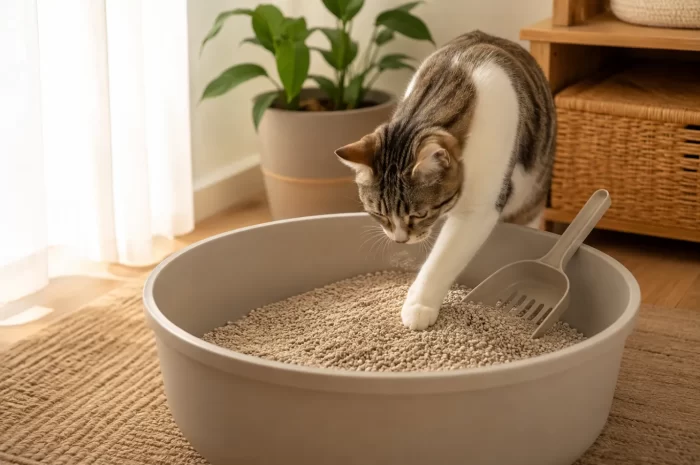
It is important that when we choose the sandbox we take into account that it is big enough so that the cat can turn around inside it.
If the cat is small, we must make sure that it is not too tall and that it can access it without problems.
Also, if it is scary, it is advisable to choose a closed tray where it feels protected. This type of closed tray helps to remove some unwanted odors thanks to its carbon fibers.
• How to prepare the sand and clean the sandbox
It is important that you choose the right type of sand according to the type of cat and family you are. If you want to know which sand is the best for your lifestyle, don’t miss our selector.
We recommend that while the kitten gets used to using its sand, you choose a product without too many aromas to avoid confusing the cat. Some of the best sands to start with are our more classic ranges:
Sepicat Classic, Sepicat Lightweight Classic, Sepicat Compact Ultra, Sepicat Lightweight Extreme Fresh or Sepicat Lightweight Ultra Antibacterial.
This does not mean that you can´t use the sands scented and emit a pleasant smell to the home, but it is better to introduce them when the cat knows how to use his sandbox without problems.
We must always check that the sandbox has about 7 cm of sand inside. Once a week or every two weeks, depending on the type of sand chosen, when the sandbox is completely emptied and cleaned, the use of strong products should be avoided. Always use soap and water.
• Take the kitten to the sand
Another important step is that, if you see the kitten start to scratch, sniff or duck in a certain area, you take her and take her to the sandbox so she understands that this is the place where she should do it.
We must never scold the kitten for not doing it in the right place and we must reward it and take it to the right place as many times as necessary.
To sum up, there are two types of kittens what they come already taught by imitation of their mother or to which we will have to teach them.
Keep in mind that everything we are going to show the kitten is new to her, we have to be patient and reinforce her positive behaviors.
If these recommendations don’t get your kitten into the right place and the problem drags on, we recommend you visit your vet to rule out any possible health problems.
For more advice and information on cats, visit our blog or social networks – we’re on Facebook!