Keeping the litter box clean is one of the essential tasks for ensuring a cat’s well-being and maintaining a pleasant environment at home. However, not all options offer the same level of absorbency, odor control, or ease of cleaning. Choosing a high-performance clumping litter can make this routine much simpler.
The key is for the liquid to quickly concentrate in a single spot to form compact clumps that can be removed without having to discard all the litter. This way, the rest of the litter remains clean while waste is removed.
But performance doesn’t depend solely on the product. The amount used, the depth of the litter, the frequency of cleaning, and each cat’s unique characteristics also play a role. That’s why understanding how clumping litter works and how to use it correctly can make daily cleaning a more efficient process.
1. The Science of Instant Clumping
The main characteristic of clumping litter is its ability to concentrate moisture and form a compact clump in a short amount of time. In Sepicat’s products, the absorbent clay particles are designed to retain liquids and facilitate their subsequent removal, preventing moisture from spreading unnecessarily throughout the litter box.
This efficiency stems from a development process that involves mineral selection, formulation, and quality controls. At Sepicat, we operate under a vertically integrated model that allows us to control various stages, from mineral extraction to the final product. Added to this are years of research and development aimed at creating solutions that meet the diverse needs of households.
When liquid comes into contact with the right particles, they bind together to form a compact clump. This makes it easier to identify the area that needs to be removed, while the rest of the litter remains available to continue absorbing.
Odor control is also linked to this absorption capacity. By concentrating moisture and facilitating frequent waste removal, the presence of odor sources within the litter box is reduced. Some formulas also incorporate specific features for odor and bacteria control.
2. Lightweight vs. Conventional Bentonite
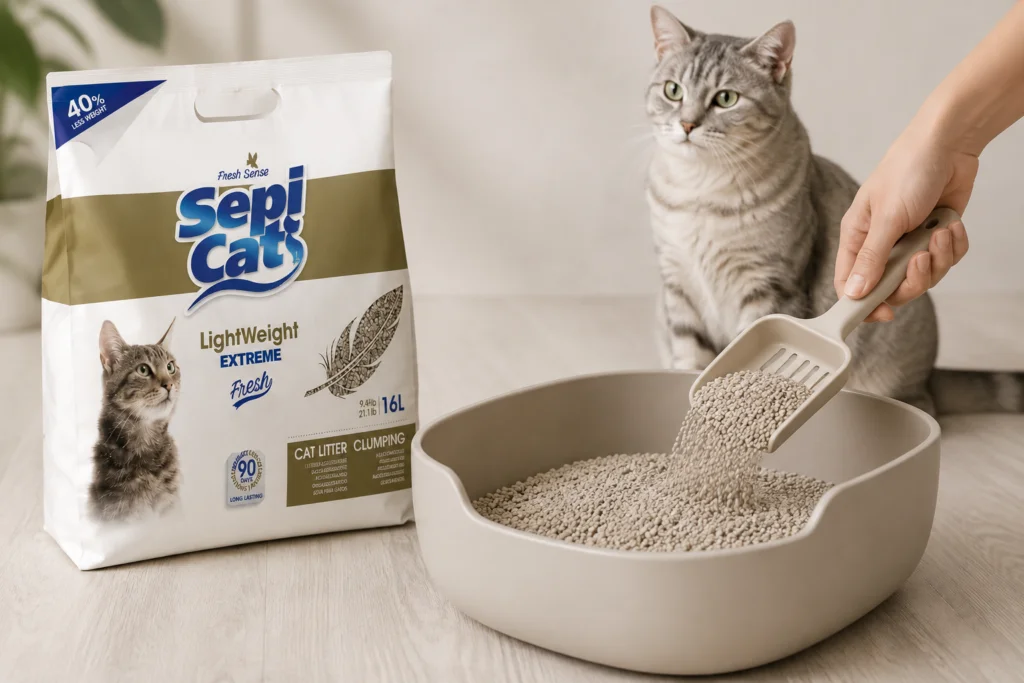
Among the alternatives currently available, lightweight litters are a useful option for those looking to reduce the effort involved in carrying, lifting, and emptying a bag of litter. Sepicat’s lightweight line is made with clay microgranules and weighs up to 40% less than conventional bentonite litters, without sacrificing its clumping ability.
When choosing a clumping litter, it’s also important to consider how easy the product is to handle, especially when litter box maintenance is part of your daily routine.
A lighter bag is easier to carry from the store to home, lift to fill the litter box, and store. This can be especially practical when cleaning is done frequently or when there are multiple litter boxes in the home.
On the other hand, conventional bentonite remains a popular choice due to its absorbency and clumping ability. The choice between the two options will depend on household priorities, product characteristics, packaging, and the cat’s preferences.
In practical terms, the comparison can be summarized as follows:
- Lightweight: lighter weight and easier to transport and handle.
- Conventional bentonite: high absorbency and clumping ability.
- Both options: allow you to remove clumps without unnecessarily discarding the entire litter.
3. Step-by-Step Guide to Perfect Filling
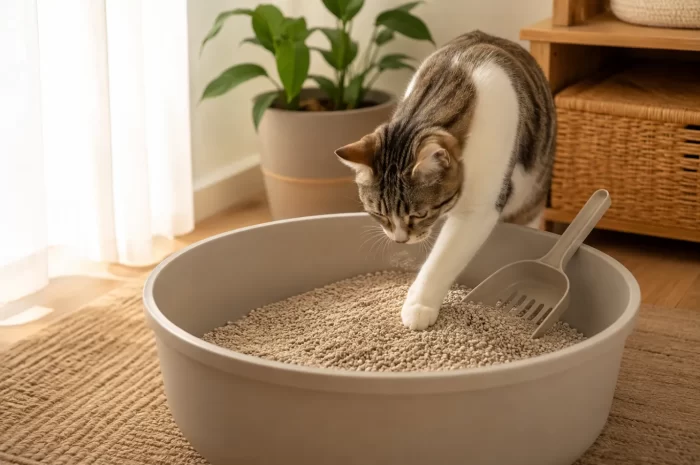
One of the keys to using clumping litter correctly is maintaining the proper depth. Sepicat recommends filling the litter box with a layer between 5 and 7 centimeters deep, ensuring that the bottom is completely covered.
Why is this important? When the layer is deep enough, liquid can be absorbed by the litter itself and form clumps before reaching the bottom of the tray. This makes it easier to scoop up the clumps with a scoop without them breaking apart or sticking to the plastic.
The procedure is simple:
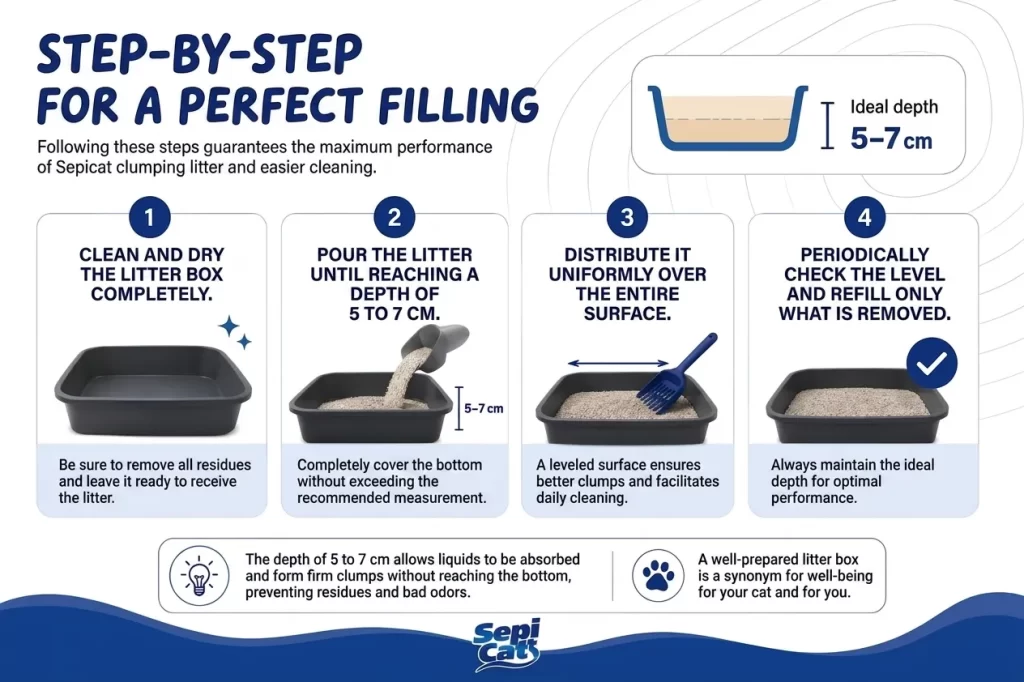
This measure also helps prevent one of the most common problems during cleaning: moisture reaching the bottom and creating residue that’s difficult to remove. Proper preparation of the litter box directly impacts the maintenance experience.
4. Daily Cleaning and Product Savings
The main advantage of high-performance clumping litter is that it changes the cleaning routine. Instead of periodically removing the entire contents of the litter box, daily maintenance focuses on locating and removing clumps formed by urine and solid waste.
To do this correctly, use a suitable scoop and remove the clumps whole, taking care not to break them apart during the process. The more compact the clump remains, the easier it will be to remove it without taking an unnecessary amount of clean litter with it.
After removing the waste, check the litter box level and add only the amount needed to restore the recommended 5 to 7 cm. It’s not necessary to discard all the litter during each cleaning: you can replenish it as you remove the waste.
This system allows the clean litter to remain in the litter box and helps reduce waste during daily routines.
To maintain better hygiene, it’s also important to deep-clean the litter box according to the needs of your household and your cat. The frequency may vary depending on factors such as the number of cats, the size of the box, and usage habits.
5. A Solution for Every Cat’s Needs
Not all cats or households have the same needs. Therefore, choosing a clumping litter shouldn’t be limited to considering absorption capacity alone. It’s also important to consider factors such as odor control, the presence of fragrances, the type of granules, and the cat’s specific characteristics.
The Sepicat product line includes options designed for different preferences. The brand offers clumping litter, both scented and unscented, as well as solutions developed to provide different user experiences.
Some criteria you might consider include:
- Odor control: useful for households where maintaining a fresh environment is a priority.
- Antibacterial options: These can be a good choice for those seeking additional hygiene benefits.
- Long-haired cats: It’s a good idea to consider particle sizes and characteristics that help reduce the amount of particles that stick to the coat.
- Mild or unscented scents: an option for households where the cat or its caregivers prefer to avoid strong fragrances.
- Product weight: Lightweight options can make transport and handling considerably easier.
A simpler routine starts with the right choice
Cleaning the litter box doesn’t have to be a complicated task. Using the right clumping litter, maintaining the correct depth, and removing clumps daily allows you to get the most out of the product and keep the space in better condition.
To help you carry out this maintenance easily, we invite you to download our [Guide to Filling the Litter Box], where you’ll find illustrated instructions on how to fill it properly and optimize your litter’s performance.
With over 35 years of experience, at Sepicat we’ve developed solutions focused on caring for cats and their homes. Today, we’re trusted by over 50 million satisfied customers, and we subject our products to strict quality controls to ensure superior performance.
If you’d like to find the right option for your cat, check out our Litter Selector and discover which option best suits your cat’s needs and those of your home. You can also purchase our products through major online retailers, such as Amazon and Mercado Libre.
Frequently Asked Questions
1. How long does a bag of cat litter last?
How long it lasts depends on the size of the litter box, the number of cats, the amount used, and how often waste is removed. When using clumping litter, daily cleaning helps better control consumption because you only replace the product that has actually been removed.
2. What kind of scoop is best for removing clumps?
A scoop with grooves suited to the size of the clumps makes it easier to separate the clumps from the clean litter. The key is that it allows you to lift the entire clump without breaking it apart or dragging along an excessive amount of litter.
3. Where is the best place to put the litter box inside the house?
It’s best to choose a quiet, accessible spot away from areas where the cat eats and drinks. You should also avoid places with too much foot traffic or sudden noises that might make the cat feel uncomfortable.
4. Is it necessary to wash the litter box every time you refill it with litter?
Not necessarily. Daily cleaning mainly involves removing waste and maintaining the proper level of litter. However, the litter box needs a periodic deep cleaning to maintain hygienic conditions, depending on usage and household needs.
5. What should I do if my cat stops using its litter box?
A sudden change in behavior can have various causes. First, check factors such as the location, cleanliness, type of litter, or recent changes in the environment. If the refusal persists or is accompanied by other behavioral changes, consult a veterinarian to rule out a health issue.