If you have one or more cats at home, you’re probably familiar with the frustration of finding tiny grains of litter in places where they shouldn’t be. After sweeping, vacuuming, or mopping, all it takes is a trip to the litter box for traces to reappear on the floor, the couch, or even the bed.
Although many people think this is inevitable, the reality is that cleaning your home with cats doesn’t have to be a constant chore. Understanding why this problem occurs and choosing the right solutions can help you keep your spaces much cleaner without affecting your pet’s comfort.
What many owners don’t realize is that litter tracking isn’t solely dependent on the cat’s habits. Factors such as the size of the litter granules, dust production, and even the design of the litter used can directly influence the amount of debris that ends up outside the litter box. Understanding these causes is the first step toward finding a truly effective solution.
Therefore, improving cleanliness in a home with cats requires analyzing not only your pet’s habits but also the quality of the products that are part of its daily routine.
Control at the Source: Science Applied to Your Litter Box
What many pet owners don’t realize is that keeping a home clean with cats depends directly on how the litter is manufactured. At Sepicat, we understand that a product’s performance shouldn’t be measured solely by its absorption capacity or odor control; it’s also essential to consider how much material remains inside the litter box after each use.
To achieve this, we operate under a vertically integrated model, which means we control the entire process—from extracting the mineral in our own mines to manufacturing and selling the final product. This complete control allows us to apply years of research and development (I+D) to create solutions with real added value for your home.
Thanks to this model—unique in the industry—we have developed specific particle sizes meticulously designed to minimize the adhesion of granules to your pet’s paws or fur. By controlling the shape and size of the mineral from its source, we ensure that the particles stay where they belong: inside the litter box.
This technological innovation not only improves cleanliness in homes with cats but also guarantees a superior hygiene experience backed by our more than 35 years of experience and the trust of over 50 million customers worldwide. By choosing a litter designed from the ground up to prevent scattering, you simplify daily maintenance and reclaim the comfort of your living spaces.
Benefits of Dust-Free Litter
There’s also another factor that directly affects household hygiene: the dust generated by some cat litters.
When cat litter produces fine particles, these can easily spread throughout the environment and settle on furniture, floors, and other nearby surfaces. As a result, cleaning tasks increase and the feeling of cleanliness decreases.
Therefore, choosing low-dust products is an important decision for optimizing cleanliness in a home with cats. An environment with fewer airborne particles not only looks cleaner but also promotes better air quality for both people and animals.
All Sepicat products undergo strict quality controls backed by years of research and development. This commitment allows us to offer solutions that help significantly reduce the presence of dust in the home.
Thanks to these standards, it’s easier to maintain a clean home with cats, even in households with multiple cats or in frequently used spaces.
Highlights of our catalog include our lightweight clumping litters, an ideal choice for those seeking simpler and more efficient maintenance. Their ability to form compact clumps makes it easier to remove waste and helps keep the litter box in better condition for longer.
Likewise, biodegradable litters are an excellent option for those who want to combine hygiene and sustainability. Made from natural materials, they help maintain a clean environment without compromising environmental responsibility.
Both the clumping and biodegradable options help reduce dust trails and make cleaning easier in households with cats, helping to keep spaces tidier and more pleasant. Furthermore, by reducing the amount of particles in the air, these solutions simplify daily maintenance and cut down on the time spent cleaning.
Supportive Accessories
In addition to choosing a high-quality litter, there are accessories that can complement your hygiene routine and enhance the results.
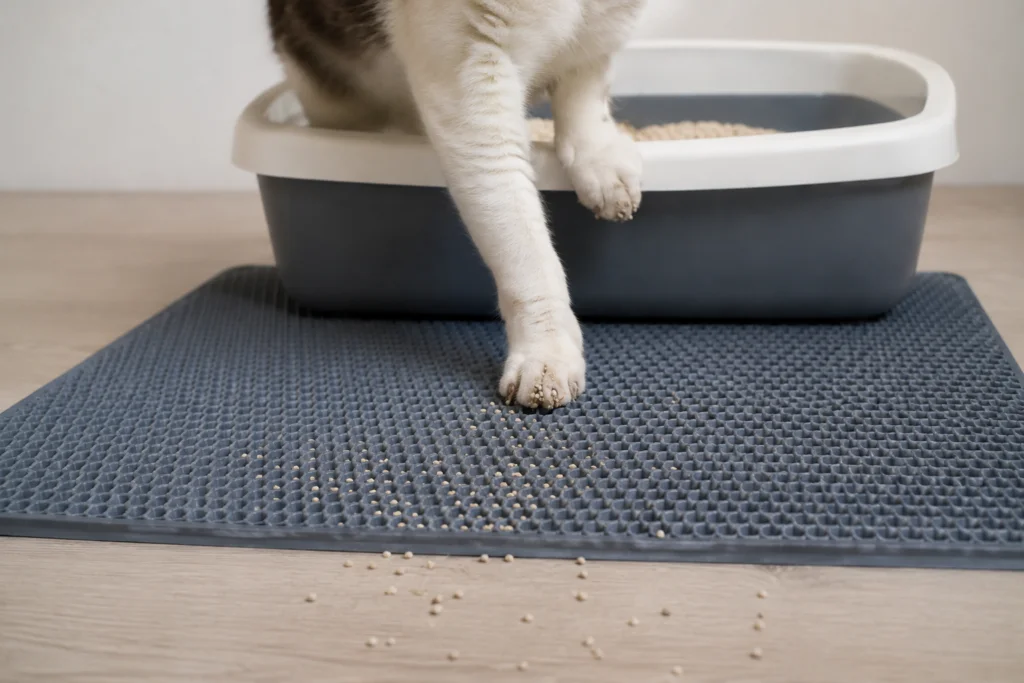
One of the most highly recommended options is litter-trapping mats. These are placed at the exit of the litter box and help trap the litter that sticks to the cat’s paws, preventing it from being tracked throughout the home.
Another important consideration is the depth of the litter box. Cats often dig before and after using the litter box, so a box with adequate sides helps contain the litter better. This simple adjustment can significantly contribute to keeping a cat-friendly home clean.
It’s also a good idea to consider the specific needs of each household. Factors such as the number of cats, the size of the available space, or the cat’s preferences can influence the choice of the most suitable litter.
That’s why Sepicat offers users its litter selector, a tool designed to help find the ideal option based on the characteristics of each cat and each household. Thanks to this solution, it’s possible to identify products that better control dust, further improving cleanliness in a home with cats.
The combination of high-performance cat litter, the right accessories, and a consistent maintenance routine can make a significant difference in daily hygiene.

Keeping a clean home when living with cats is entirely possible. Choosing high-quality litter and using supportive accessories are practical, long-term ways to improve cleanliness in a cat-friendly home.
By choosing Sepicat, you not only get a solution designed to reduce litter tracking and simplify daily hygiene, but you also support a brand committed to animal welfare, sustainability, and various social initiatives that help improve the lives of cats most in need.
When you combine the right products with consistent cleaning habits, keeping your spaces tidy stops being a daily challenge and becomes a much simpler task.
Better hygiene doesn’t just depend on cleaning more—it depends on choosing solutions designed to make your day-to-day easier. If you want to reduce litter tracking, control dust, and find the option that best suits your cat and your home, try our litter selector and discover why millions of people trust Sepicat’s solutions to keep their spaces cleaner and more comfortable.
Frequently Asked Questions
1. Does the type of litter box (open or closed) affect how much litter gets scattered?
Yes. A litter box with high sides or a top-entry design helps physically contain the litter when your cat digs. However, this measure should be complemented with low-tracking litter to prevent particles stuck to your cat’s paws from ending up outside the litter box.
2. Do lightweight litters spread more because they’re lighter?
Not necessarily. Although they are lighter for easier transport and handling, Sepicat’s Lightweight litters are formulated to form compact clumps quickly. This helps reduce the number of loose grains and promotes a more efficient cleaning experience without compromising performance.
3. How can I effectively clean up litter that has already spread throughout the house?
We recommend using a vacuum cleaner with a HEPA filter to prevent dust from being released back into the air. You can also use a slightly damp microfiber cloth to pick up the finest particles. However, the best strategy is still prevention by using a litter designed to minimize tracking.
4. How often should I completely change the litter to maintain floor hygiene?
The frequency depends on the type of litter and the number of cats using the litter box. For high-performance clumping litters, it’s sufficient to remove waste daily and replenish the necessary amount of litter. Generally, a complete change every two to four weeks helps maintain optimal hygiene.
5. What should I do if my cat rejects a new litter designed to leave no traces?
The transition should be done gradually. Ideally, mix the usual litter with the new one for about a week, gradually increasing the proportion of the new product. This process helps your cat adjust and reduces the likelihood of rejection.