Many people have doubts, fears and uncertainties when they are pregnant and have a cat at home.
There is a widespread theory in which it is thought that cats and pregnant women should not live together due to the multiple problems that can arise to the fetus and the woman.
For this reason, many people, when they decide to have a baby, recommend that they get rid of their cat.
Are there any health risks for having a cat?
The answer is no, as long as certain precautions are maintained during pregnancy.
What is Toxoplasmosis?
Toxoplasmosis is a disease caused by the parasite Toxoplasma gondii, which could cause malformations in the fetus and affects warm-blooded animals.
How is Toxoplasmosis transmitted?
Felines are their only definitive hosts, that is, they are the only ones that eliminate eggs by expelling them into the environment through feces.
This does not mean that cats are the only source of infection. This parasite can also be found in vegetables, fruits, legumes, sausages and undercooked meats.
In the case of cats, they can get infected by eating raw meat contaminated with the parasite or through the feces of other infected cats.
It is important to keep in mind that, in the event that the pregnant woman has already passed the disease, she cannot be infected again and therefore the baby will not be at risk.
During the first weeks of pregnancy the woman should have a test that confirms or rules out this option, as well as ruling out that her cat may already be infected.
It is important to note that most cats are seropositive, that is, they have antibodies and cannot get it again.
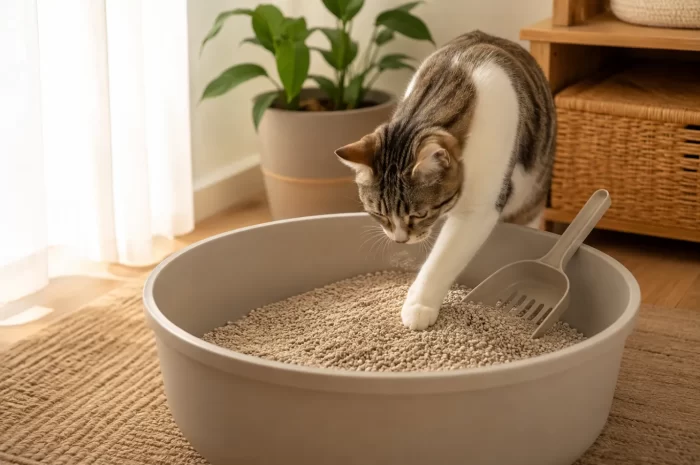
In addition, eggs need to be at least 24 hours at room temperature for them to infect, so a daily cleaning of the litter box is key to avoid problems.
Recommendations:
The pregnant woman should not carry out the task of cleaning the litter box of her pet or let her cat go outside, since she could come into contact with other cats that are infected.
Another important measure is to monitor what the kitten eats. As long as you feed it with food specially for pets, either wet or dry, there is no problem.
During pregnancy, it is highly recommended that you watch that your cat does not eat any type of raw meat. Also, hunting of birds, rodents or any other type of animal is prohibited.
Finally, being an orally transmitted disease, you should not only wash your hands and not put them in your mouth after being in contact with cats that could be infected; instead, you should avoid eating any type of raw meat and wash with special care the vegetables you are going to eat, as well as your hands after handling them.
How to clean the litter box during pregnancy:
As we have said, as far as possible it is good that the pregnant woman does not perform this task to avoid possible problems.
In case there is no other option, we recommend:
- Clean the litter box daily
- Wear gloves and mask when cleaning the litter box
- Wash hands after handling the litter
- Take extreme hygiene measures in the litter box environment to avoid cross contamination
As you can see, toxoplasmosis is not a disease that can only be transmitted by your cat, but the source of contagion occurs in several places.
With a few simple guidelines you will avoid getting infected and always, when in doubt, you can go to your doctor or veterinarian.
As always, if you want more information about cats and cat litter, you can consult our website.