If you’ve just adopted a cat or already live with one, do you know which vaccines your cat needs in Spain and which are mandatory? In this blog you’ll find a practical, clear, and up-to-date guide on essential and recommended vaccines, as well as the requirements under the Animal Welfare Law.
Why Is It Important to Vaccinate Your Cat?
Vaccines not only protect your cat from potentially fatal diseases such as panleucopenia or feline leukaemia, but they are also a legal and ethical responsibility as a pet guardian. A cat’s immune system—especially during their first months of life—needs support to fight off common viruses and bacteria, many of which spread easily in urban environments or between animals.
The Animal Welfare Law in Spain and Cat Vaccinations

As we explained in our previous blog, “Impact of the Animal Welfare Law in Spain on Your Cat”, the updated law requires not only microchipping and registration, but also a series of basic veterinary care measures, including vaccination. While some vaccines are mandatory in certain regions, others are strongly recommended by the veterinary community to ensure animal wellbeing. Rabies, for example, is compulsory in regions such as Galicia and Catalonia, while in others it is considered voluntary.
Feline Vaccination Schedule in Spain
Vaccines are administered in stages, beginning around 8 weeks of age. The schedule recommended by vets and endorsed by the WSAVA is as follows:
| Cat’s Age | Vaccine | Disease Prevented | Mandatory |
| 8 weeks | Feline trivalent | Panleucopenia, Rhinotracheitis, Calicivirus | No* |
| 12 weeks | Trivalent booster + Rabies | Same + Rabies | Yes, in Galicia & Catalonia |
| 16 weeks | Trivalent + Leukaemia (FeLV) | Same + Feline leukaemia | No* |
| 19 weeks | FeLV booster | Feline leukaemia | No* |
| Annually | Trivalent booster, Rabies & FeLV | Maintain immunity | Depends |
*Note: Requirements may vary by autonomous community. Always check with your vet for the specific rules in your region.
Common Diseases Prevented by Cat Vaccines
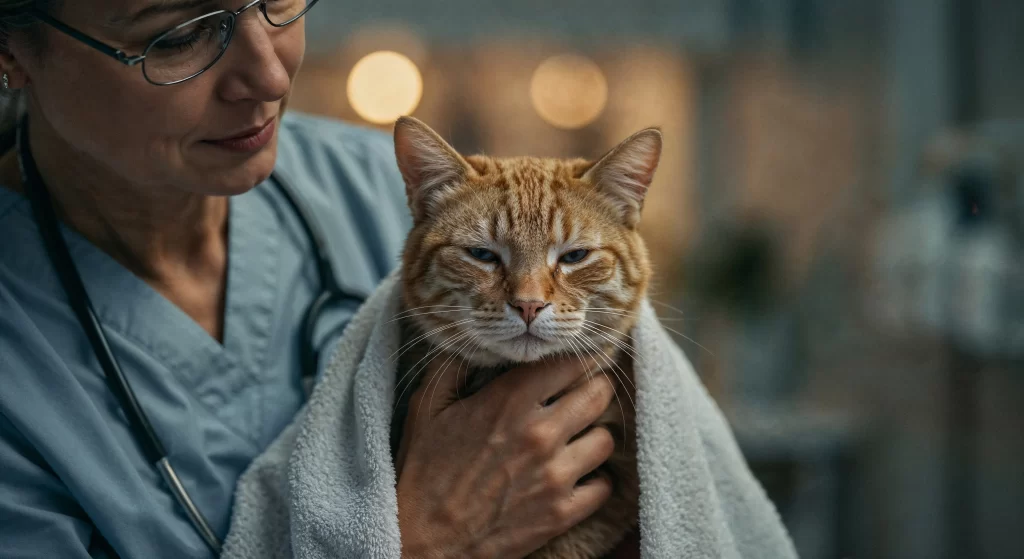
- Feline panleucopenia: Highly contagious; causes vomiting, diarrhoea, and severe dehydration. Fatal without rapid treatment.
- Feline rhinotracheitis (Herpesvirus): Serious respiratory infection; may become chronic and affect the eyes, nose, and throat.
- Feline calicivirus: Affects the respiratory system and may cause painful mouth ulcers. Very common in stray or unvaccinated cats.
- Feline leukaemia (FeLV): Viral disease that weakens the immune system; transmitted via saliva or blood.
- Rabies: Deadly and zoonotic. Rare in cats, but still a public health threat.
Before Vaccinating: Prepare Your Cat

To ensure vaccine effectiveness and minimise side effects, it’s important to:
- Deworm your cat: Both internally and externally.
- Check overall health: Avoid vaccinating if they are unwell.
- Assess weight: Overweight cats may respond less effectively.
- Run pre-tests: For FeLV, a test is recommended before vaccination.
Possible Side Effects
Vaccines are generally safe, but like any medical procedure, mild reactions may occur:
- Lethargy or mild fever for 24–48 hours.
- Slight swelling at the injection site.
- Rarely, allergic reactions (vomiting, hives, difficulty breathing).
- In very rare cases, an injection-site sarcoma (FISS) may develop. Vets use the “3-2-1 rule” to detect them: if a lump persists for over 3 months, measures more than 2 cm, or grows within 1 month, it must be evaluated.
What If You Have an Unvaccinated Adult Cat?
If your adult cat has never been vaccinated, it’s not too late to start. Your vet will carry out a general assessment, possibly run FeLV and FIV tests, and create a vaccination plan tailored to your cat’s health and lifestyle.
Tips to Protect Your Cat’s Immune System
Vaccines are key, but not the only tool. To strengthen your cat’s immunity:
- Provide a balanced, high-quality diet.
- Keep their environment clean and stress-free.
- Maintain regular vet check-ups.
- Offer mental and physical stimulation.
Vaccinating your cat is not just a legal requirement—it’s an act of love. Speak to your vet today and ensure your feline friend enjoys a long, healthy life.Want more practical tips on cat care? Read our Beginner’s Guide to Raising Domestic Cats.
Does my cat need vaccines if they never go outside?
Yes. Even without outdoor access, some viruses can be carried in on clothing or shoes. Also, if you ever need to take them to the vet, they’ll be better protected.
Is the rabies vaccine always compulsory?
Not everywhere in Spain. It’s mandatory in regions such as Galicia and Catalonia. In other areas, it’s voluntary but recommended for public health reasons.
What happens if I don’t vaccinate my cat?
Besides putting their health at risk, you may face penalties if you live in a region where certain vaccines are required.
Can I vaccinate my cat at home?
Not recommended. Vaccines must be administered by a licensed vet, who will also record the official vaccination.
Do vaccines wear off in cats over time?
Yes. That’s why annual or periodic boosters are required, depending on the duration of immunity (DOI) of each vaccine.